
OpenAPI Integration
The bundle seamlessly integrates with nelmio/api-doc-bundle to automatically generate OpenAPI (Swagger) documentation from your JSON Schemas.
Single Source of Truth
This is the core philosophy of the bundle: your JSON Schema is the single source of truth for both validation AND documentation.
How It Works
- You write one JSON Schema file
- The bundle uses it to validate requests
- The same schema is embedded directly into OpenAPI specification
- Documentation always matches actual validation (impossible to desync)
Why This Matters
Traditional approach (prone to errors):
// Validation rules
#[Assert\NotBlank]
#[Assert\Email]
private string $email;

// Documentation (separate, can drift!)
/**
 * @OA\Property(type="string", format="email")
 */
Our approach (single source of truth):
{
  "properties": {
    "body": {
      "properties": {
        "email": {
          "type": "string",
          "format": "email",
          "description": "User email address"
        }
      }
    }
  }
}
This one schema:
- ✅ Validates the request
- ✅ Generates OpenAPI docs
- ✅ Always in sync (physically impossible to diverge)
OpenAPI 3+ Native Compatibility
Important: JSON Schema is not converted to OpenAPI - it IS part of OpenAPI 3+.
OpenAPI 3.0+ uses JSON Schema natively for request/response bodies:
# OpenAPI 3.1 spec
components:
  schemas:
    User:
      # This IS JSON Schema, not a conversion
      type: object
      properties:
        email:
          type: string
          format: email
The bundle's MapRequestArgumentDescriber embeds your JSON Schema directly into the OpenAPI spec.
Setup
Install nelmio/api-doc-bundle:
composer require nelmio/api-doc-bundleThe integration happens automatically. No additional configuration needed.
Automatic Documentation
When you use #[MapRequest], the bundle automatically:
- Detects the JSON Schema file
- Embeds it into OpenAPI specification
- Generates request body documentation
- Adds validation constraints to the docs
Example
This example demonstrates how JSON Schema validation integrates with OpenAPI documentation:
Controller:
<?php

namespace App\Controller;

use App\Dto\UserApiDtoRequest;
use App\Dto\UserApiDtoResponse;
use Nelmio\ApiDocBundle\Attribute\Areas;
use Nelmio\ApiDocBundle\Attribute\Model;
use OpenApi\Attributes as OA;
use Outcomer\ValidationBundle\Attribute\MapRequest;
use Symfony\Bundle\FrameworkBundle\Controller\AbstractController;
use Symfony\Component\HttpFoundation\JsonResponse;
use Symfony\Component\Routing\Attribute\Route;

#[Areas(['examples'])]
#[OA\Tag('Examples')]
#[Route('/_examples/validation')]
class UserController extends AbstractController
{
    #[OA\Post(
        operationId: 'createUser',
        summary: 'Create a new user',
        description: 'Creates a new user with JSON Schema validation',
        responses: [
            new OA\Response(
                response: 200,
                description: 'User created successfully',
                content: new OA\JsonContent(
                    ref: new Model(type: UserApiDtoResponse::class)
                )
            ),
            new OA\Response(
                response: 400,
                description: 'Validation error',
                content: new OA\JsonContent(
                    properties: [
                        new OA\Property(property: 'message', type: 'string'),
                        new OA\Property(property: 'errors', type: 'object'),
                    ],
                    type: 'object'
                )
            ),
        ]
    )]
    #[Route('/api/users', methods: ['POST'])]
    public function createUser(#[MapRequest('user-create.json')] UserApiDtoRequest $user): JsonResponse
    {
        $userData = UserApiDtoResponse::fromArray([
            'name'  => $user->name,
            'email' => $user->email,
            'age'   => $user->age,
        ]);

        return $this->json($userData, 200);
    }
}
JSON Schema (config/validation/schemas/user-create.json):
{
  "$schema": "https://json-schema.org/draft-07/schema#",
  "type": "object",
  "properties": {
    "headers": {
      "type": "object",
      "properties": {
        "authorization": {
          "type": "string",
          "description": "Bearer token for authentication",
          "pattern": "^Bearer .+",
          "example": "Bearer eyJhbGciOiJIUzI1NiIsInR5cCI6IkpXVCJ9..."
        },
        "x-api-version": {
          "type": "string",
          "description": "API version",
          "enum": ["v1", "v2"],
          "example": "v1"
        }
      },
      "additionalProperties": true
    },
    "body": {
      "type": "object",
      "properties": {
        "name": {
          "type": "string",
          "minLength": 3,
          "maxLength": 100,
          "description": "User's full name",
          "example": "Jane Smith"
        },
        "email": {
          "type": "string",
          "format": "email",
          "description": "User's email address",
          "example": "john.doe@example.com"
        },
        "age": {
          "type": "integer",
          "minimum": 21,
          "maximum": 100,
          "description": "User's age (optional)",
          "example": 30
        }
      },
      "required": ["name", "email"],
      "additionalProperties": false
    }
  }
}
The schema is automatically embedded in OpenAPI documentation. No duplicate annotations needed.
Viewing Documentation
To generate and view OpenAPI documentation:
Generate OpenAPI specification with nelmio:
bashphp bin/console nelmio:apidoc:dump --format=yaml > api.yamlCreate a documentation controller:
php<?php namespace App\Controller; use Symfony\Bundle\FrameworkBundle\Controller\AbstractController; use Symfony\Component\HttpFoundation\Response; use Symfony\Component\Routing\Attribute\Route; class DocsController extends AbstractController { #[Route('/api-docs', name: 'api_docs', methods: ['GET'])] public function docs(): Response { $html = <<<'HTML' <!DOCTYPE html> <html> <head> <title>API Documentation</title> <meta charset="utf-8"/> <meta name="viewport" content="width=device-width, initial-scale=1"> <link href="https://fonts.googleapis.com/css?family=Montserrat:300,400,700|Roboto:300,400,700" rel="stylesheet"> <style> body { margin: 0; padding: 0; } </style> </head> <body> <redoc spec-url="/api.yaml"></redoc> <script src="https://cdn.redoc.ly/redoc/latest/bundles/redoc.standalone.js"></script> </body> </html> HTML; return new Response($html); } #[Route('/api.yaml', name: 'api_spec', methods: ['GET'])] public function apiSpec(): Response { $yamlPath = $this->getParameter('kernel.project_dir') . '/api.yaml'; if (!file_exists($yamlPath)) { throw $this->createNotFoundException('API specification not found'); } $yamlContent = file_get_contents($yamlPath); return new Response($yamlContent, 200, [ 'Content-Type' => 'text/yaml', 'Access-Control-Allow-Origin' => '*' ]); } }Access your documentation at
http://localhost/api-docs
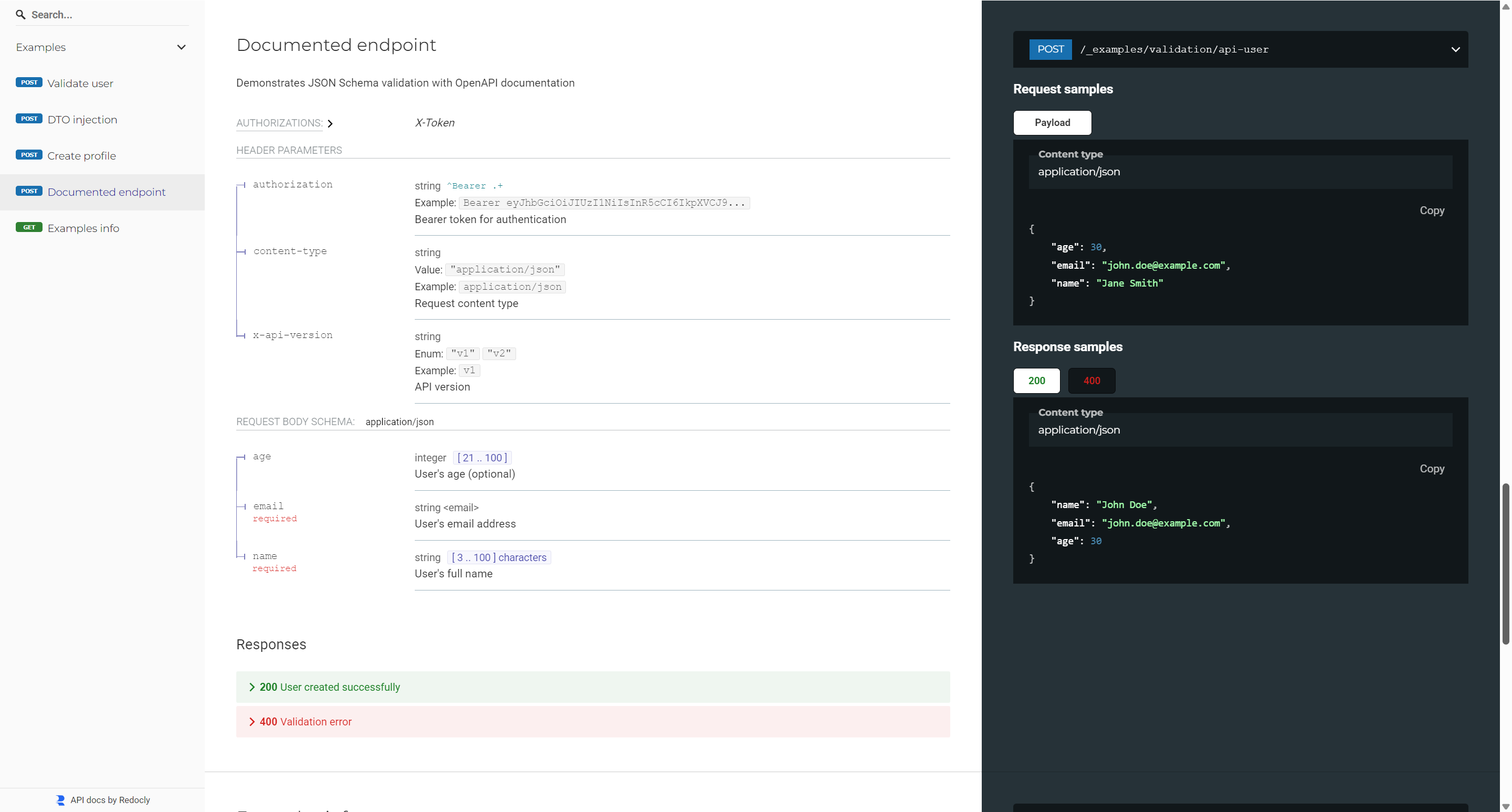
The documentation will display:
- All endpoints with
#[MapRequest] - Request/response schemas embedded from JSON Schema
- Validation rules and constraints
- Required headers, query parameters
- Examples and descriptions
Contract-First Development
This bundle enables true Contract-First Development:
- Design your API contract (JSON Schema)
- Validate requests against it automatically
- Document it automatically in OpenAPI
- Implement the business logic
The schema is the contract. Code must conform to it.
Benefits:
- API design happens first
- Documentation is always accurate
- Frontend and backend teams work from same contract
- No drift between docs and implementation
Next Steps
- Schema Basics → - Learn JSON Schema syntax
- DTO Injection → - Type-safe DTOs
- Examples → - Real-world examples